
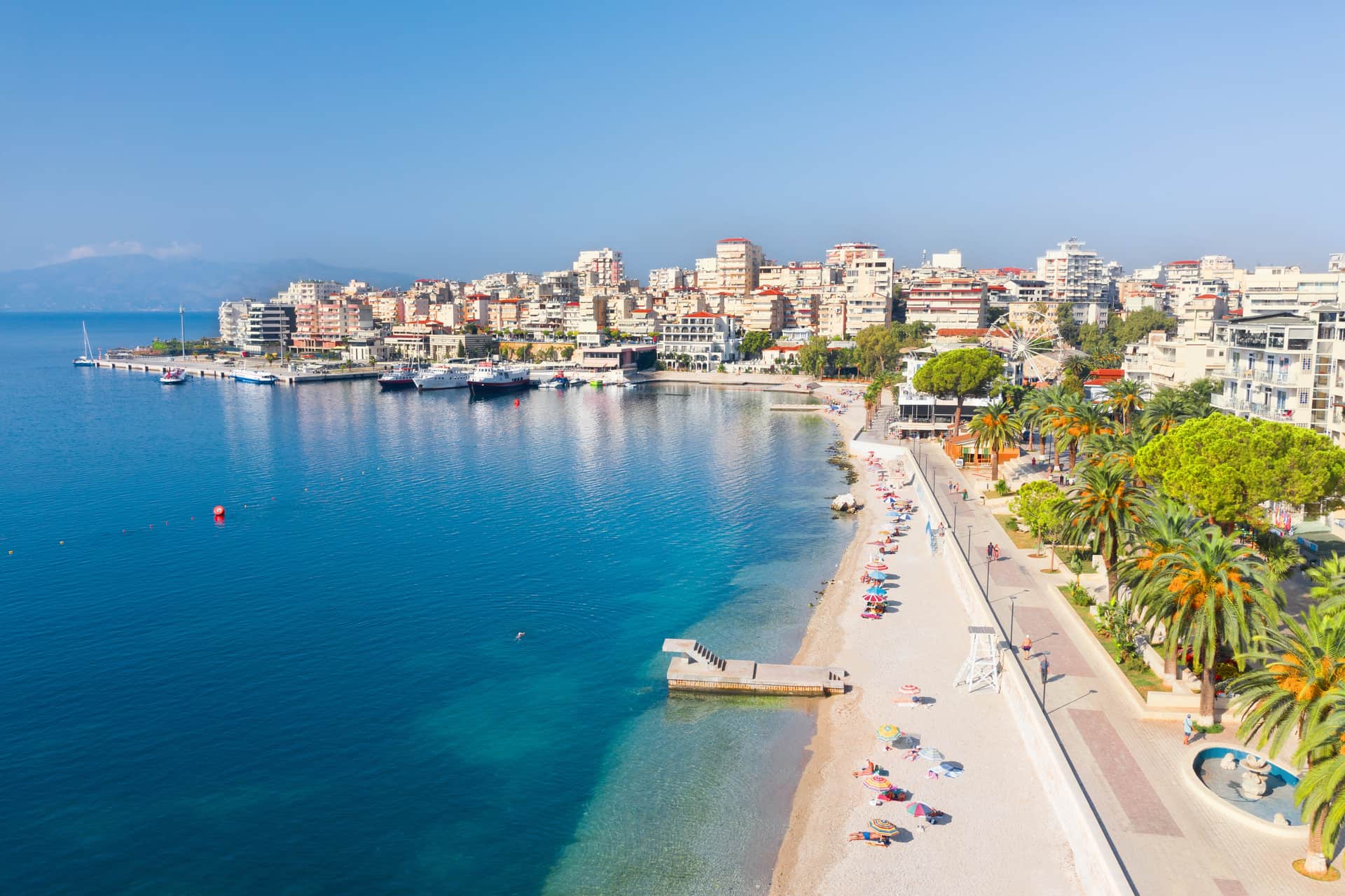
Is property in Albania a good investment? The short answer
It can be, for a buyer who pays cash, plans to hold for years and checks the numbers on a net, full-year basis. Entry prices are low for a Mediterranean coast, a foreigner owns an apartment outright with the same rights as a citizen, the annual property tax is 0.05% of value and rental income is taxed at a flat 15%.
It is a poor fit for anyone who needs a mortgage, a quick resale or a guaranteed income. Albanian banks rarely lend to non-residents, the coastal rental season is short, and the market has no escrow system, so the safety of the purchase depends on the checks you run before you pay. The sections below put numbers on each of these points.
- Long-term rental yield, Tirana
- 5–7% gross
- Holiday rental yield, south coast
- 8–12% gross, peak season
- Realistic full-year net yield
- ~4–6%
- Tax on rental income
- 15% flat
- Annual property tax
- 0.05% of value
- Closing costs
- ~4–7% of the price
- Median seaside apartment (asking price, September 2026)
- €112,500
A 10% yield quoted for an August week is not a 10% return. Over a full year, after costs and tax, most Albanian rentals land between 4 and 6% net.
Rental yields in Albania by city
Albania has no public register of achieved rents, so every yield figure you read is an estimate. The ranges below are the ones that survived our own fact-checking; several higher figures that circulate online did not. Use them as a starting point and test them against the rents actually asked for comparable flats in apartments for rent in Albania.
- Tirana, long-term let
- 5–7% gross
- Durrës Beach and Golem, long-term let
- ~5.7% net
- Sarandë, long-term let
- ~4.4% net
- Vlorë, long-term let
- ~4.3% net
- Sarandë and Ksamil, holiday let
- 9–12% gross, peak season
- Vlorë, holiday let
- 8–11% gross, peak season
Gross yield vs net yield
Gross yield is a year of rent divided by the purchase price. Net yield takes off what the owner really pays (management, cleaning, repairs, building charges, empty weeks and tax) and divides by the full outlay, closing costs included. Sellers quote gross. You live on net. In Albania the gap is wide: coastal holiday lets quoted at 8 to 12% gross come out at roughly 4 to 6% net.
Peak season vs full year
Holiday-let yields on the coast are often calculated from July and August rates. Demand on the Riviera concentrates in the summer months and falls sharply in winter, so a nightly rate that fills the flat in August says little about November. When an agent or manager quotes a yield, ask for the number of nights booked over the past twelve months, not the summer price list.
Short-term or long-term rental in Albania: which pays more
The two strategies are taxed differently, and that changes the result more than most buyers expect. A long-term tenancy is taxed at 15% of net income, after allowable costs. A short-term (holiday) rental is taxed at 15% of gross income, with no deductions, declared through the tax administration’s DIVA platform. On a holiday let, cleaning, platform commission and management do not reduce the tax bill; they come out of what is left after it.
Long-term letting works where people live and work all year: Tirana first, then Durrës and Vlorë. Holiday letting works where tourists want to be: Sarandë, Ksamil, Himarë, Dhërmi and the beach strip of Durrës and Golem. A holiday flat earns more per night, but it needs a manager on the spot, regular cleaning and someone to answer guests, and it stands empty for much of the low season. How each type of income is declared is covered in property taxes in Albania.
- Long-term let: tax
- 15% of net income
- Holiday let: tax
- 15% of gross income, via DIVA
- Long-term let: where
- Tirana, Durrës, Vlorë
- Holiday let: where
- Sarandë, Ksamil, Himarë, Dhërmi, Golem
- Long-term let: workload
- Low, one tenant
- Holiday let: workload
- High, needs a local manager
What it costs to invest: apartment prices in Albania by market
Yield is rent divided by price, so the entry price matters as much as the rent. The figures below are median asking prices for apartments from the BalkanHome listings database, snapshot of 6 September 2026. They are asking prices, not transaction prices; the price finally paid can differ.
Across the whole strip within 5 km of the sea the median is €1,513/m² and the median apartment asks €112,500. Four in ten seaside apartments are priced under €100,000. For comparison, average asking prices in Montenegro’s coastal towns run 1.6 to 2.5 times higher, from €2,797/m² in Bar to €4,391/m² in Tivat. The full tables, with quartiles and the price of being close to the beach, are in our report on property prices in Albania.
On top of the price, budget 4 to 7% for closing costs: notary, Cadastre registration, legal fees and the municipal transfer charge. The line items are in the cost of buying property in Albania.
- Golem
- €1,353/m² · median apartment €90,000
- Qerret
- €1,500/m² · median apartment €107,474
- Shëngjin
- €1,550/m² · median apartment €112,988
- Durrës
- €1,577/m² · median apartment €131,579
- Tirana
- €1,859/m² · median apartment €177,320
- Sarandë
- €1,904/m² · median apartment €152,719
- Vlorë
- €2,207/m² · median apartment €208,000
- Dhërmi
- €3,074/m² · median apartment €323,918
Worked example: from a 6% gross yield to the net return
Take an apartment at €112,500, the median asking price of a seaside apartment in our data, let long-term at a 6% gross yield. The 20% allowance for management, repairs and empty weeks is an assumption made for the example; replace it with real quotes from a local manager before you decide.
- Purchase price
- €112,500
- Closing costs at 5%
- €5,625
- Total outlay
- €118,125
- Rent at 6% gross
- €6,750 a year (about €560 a month)
- Management, repairs, empty weeks (assumed 20%)
- −€1,350
- Net income before tax
- €5,400
- Income tax, 15% of net income
- −€810
- Annual property tax, 0.05%
- −€56
- What you keep
- €4,534 a year
- Net yield on total outlay
- 3.8%
The same apartment as a holiday let
Suppose the flat takes €9,000 in bookings over the year, an 8% gross yield. The 15% tax is charged on the full €9,000, so €1,350 goes to tax whatever your costs were. If management, cleaning, platform commission and utilities take 35% of bookings (again an assumption), that is another €3,150. After €56 of property tax you keep about €4,440, or 3.8% on the total outlay.
The holiday let took in a third more rent and ended in the same place. It pulls ahead only when the flat is also booked outside July and August, which is why the booking history matters more than the nightly rate.
Capital growth in Albania: what you can and cannot count on
Most optimistic cases for Albania rest on prices continuing to rise. The arguments are real: the coast is priced well below neighbouring Montenegro, tourism has grown quickly, and Albania is an EU candidate country in accession negotiations.
None of that is a guarantee. No accession date is set. Our own data is a snapshot of asking prices, not a price history, so we do not publish a growth rate, and you should be wary of anyone who quotes one without saying where it comes from. New supply is heavy in places: Golem, Durrës and Qerret alone account for about three quarters of the apartments for sale near the sea in our database, so many similar flats will compete with yours when you sell.
When you sell, the gain is taxed at 15%. Resale is easiest in Tirana, the most liquid market in the country; a holiday flat in a resort town has a narrower pool of buyers. A sound rule: buy only if the rental numbers work on their own, and treat any rise in value as a bonus.
Risks of investing in Albanian property
Investors in Albania rarely lose money to a market crash. They lose it to avoidable mistakes at the purchase. Each risk below has a specific check, set out in is it safe to buy property in Albania.
- Title: some older and informally built properties have incomplete paperwork. Have an independent lawyer confirm a clean, registered title at the State Cadastre (ASHK) before any money moves.
- Off-plan: much of the cheaper coastal stock is sold before completion. Check the building permit, check that the land is registered to the developer, and tie payments to construction stages.
- No escrow: funds pass through the notary, not an escrow account. Never pay a large sum against an unregistered promise.
- Seasonality: a coastal flat can be full in August and close to empty in winter. Budget on twelve-month occupancy.
- Financing: Albanian banks rarely lend to non-residents, so plan to buy with your own funds or a developer’s instalment plan.
- Tax changes: a market-value reform of the annual property tax has been proposed, with draft rates of 0.1 to 0.2% instead of 0.05%. It is not confirmed in force; check the current rate.
- Management at a distance: a rental you cannot visit needs a reliable local manager. Agree fees, reporting and who holds the keys in writing.
Who should invest in Albanian property, and who should not
A good fit
- Cash buyers who plan to hold for years.
- Buyers who want a holiday home that pays part of its own costs.
- Investors who want year-round tenants and accept a moderate yield: Tirana.
- Buyers with a smaller budget who want a seaside asset: in Golem the median apartment asks €90,000.
A poor fit
A purchase in Albania does not bring a passport or automatic residency. There is no golden visa; ownership can only support a renewable one-year permit, explained in residence permit through property in Albania.
- Anyone who needs a mortgage to buy.
- Anyone counting on a quick resale at a profit.
- Anyone who needs the rent to arrive evenly every month from a holiday flat.
How to choose an investment property in Albania
Decide the strategy first, then the town, then the flat. Where each strategy works is compared in the best places to buy property in Albania.
Two figures from our data help with pricing. A declared sea view is associated with an asking price about 15% higher. On the Bay of Durrës the first 100 metres from the beach cost about 13.5% more per square metre than the next 200 metres; on the Riviera distance to the beach does not order prices at all, the specific spot does.
- Work out the net yield yourself: twelve months of rent, minus costs, minus 15% tax, divided by price plus closing costs.
- For a holiday let, ask for twelve months of booking history for the flat or the building, not a projection.
- Compare the asking price with the median €/m² for the town. A flat far above the median needs a reason: sea view, first line, parking.
- Find out who will manage the flat and what they charge before you buy, not after.
- If you want rent from day one, prefer a completed building with a registered title.
- Have an independent lawyer, paid by you, check title and permits.
Key takeaways
- Judge Albanian property on full-year net yield, about 4 to 6%, not on the 8 to 12% quoted for peak season.
- Tirana suits year-round letting (5 to 7% gross); Durrës Beach and Golem lead on net long-term returns (about 5.7%).
- Holiday lets pay 15% tax on gross income, long-term lets 15% on net, so costs hit holiday lets harder.
- Entry prices are low: the median seaside apartment asks €112,500 and four in ten are under €100,000.
- Buy with your own funds, a verified title and a rental case that works without price growth.
Frequently asked questions
Is Albania a good place to invest in real estate in 2026?
What is the average rental yield in Albania?
Is Airbnb profitable in Albania?
Where is the best place to invest in property in Albania?
How much money do I need to invest in property in Albania?
Do foreigners pay tax on rental income in Albania?
Will property prices in Albania keep rising?
Find an investment property in Albania
Browse apartments and houses for sale, compare the price per m² by town and contact the seller directly. Free for buyers.
Browse listingsThis guide is general information, not legal or tax advice. Verify current rules with a qualified Albanian attorney or notary before you buy.