Winter weather in Albania: temperatures, rain and sea by town
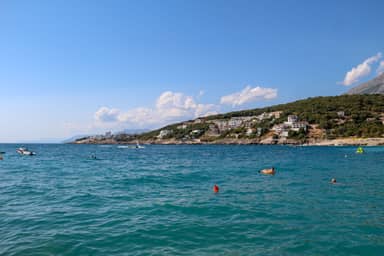
The Albanian coast has a Mediterranean winter: mild, wet and short. On the climate normals for 1991 to 2020, January in Durrës and Vlorë runs between about 4 degrees at night and 13 to 15 by day, with 130 to 145 mm of rain spread over 13 or 14 days. November is the wettest month on the coast and in Tirana, not January. The sea is 14 degrees from January to March, warm enough for a few hardy swimmers and nobody else. Sarandë and the Riviera share the climate of Vlorë with a little more sun and shelter from the north.
Tirana, 30 km inland, is a degree or two colder at night and wetter in November and December. Real winter is in the mountains and the south-east: Korçë at 900 metres has January nights below freezing, snow, and a proper continental season. The coast also gets cold snaps when the wind turns north-east, a few days a year when 5 degrees and damp feel colder than they sound in a building with no insulation.
- Durrës, January
- 4 to 13 °C, 130 mm of rain over 13 days, sea 14 °C
- Vlorë (and the Riviera), January
- 4 to 13 °C, 145 mm over 14 days, sea 14 °C
- Tirana, January
- 2 to 12 °C, 135 mm over 10 days
- Korçë (900 m), January
- −2 to 5 °C, 70 mm, snow
- Wettest month on the coast
- November: 160 to 170 mm
- Sunniest winter month
- March: 5 to 6 hours of sun a day on the coast
The practical version: from mid-November to the end of February expect a wet week in every two, daytime temperatures that allow a coat and a coffee outside, and nights that call for heating. March is a different season, dry, bright and already 18 degrees by day on the coast.
What stays open on the coast from November to March
This is the question that matters, and the answer depends entirely on the town. Albania has two kinds of coastal places: real towns, where the beach is an extra, and resort strips, where the beach is the reason the place exists. The first kind lives in winter. The second closes.
- Tirana
- The capital. Nothing changes in winter except the weather.
- Durrës
- A port city with a year-round population; the beach promenade south of the city goes quiet.
- Vlorë
- A real city with shops, schools and a university; the Lungomare empties but the centre does not.
- Sarandë
- A small town that stays open: shops, cafés, the Corfu ferry once a day, most hotels closed.
- Shkodër, Korçë, Pogradec
- Inland towns with normal winter life; Korçë has snow and a winter season of its own.
- Ksamil
- Resort village: beach bars and most restaurants shut, a few places open, Butrint open all year.
- Himarë, Dhërmi, Vuno
- Most hotels and beach businesses close from November to March; the village cafés carry on.
- Golem, Qerret, Mali i Robit
- A belt of new holiday apartments; many buildings are largely empty in winter.
If you plan to live on the coast year-round, this table is the shortlist. Vlorë, Durrës and Sarandë give you a winter with neighbours, a pharmacy and a plumber who answers the phone. Ksamil, Himarë and Dhërmi give you the best summers in the country and a very quiet January. The full comparison of what each market suits is in the best places to buy property in Albania.
See the apartment in January. If you still want it when the beach bar is shuttered and the rain is coming sideways off the Ionian, you want it for the right reasons.
Getting to the Albanian coast in winter: flights and ferries
Albania has one working international airport for most of the country, and it is in Tirana. It is well served in winter: Wizz Air bases aircraft there and runs some 57 routes to 18 countries, Ryanair opened a Tirana base in March 2026, and the big Western European cities have year-round connections. From the airport the central coast is 40 minutes by road, Vlorë about two hours and Sarandë four to five.
The airport that was supposed to change this, Vlora International, has been built but has not opened. Its first certification flight landed in May 2025, the summer 2026 charters were cancelled, and in August 2026 the state began the procedure to terminate the concession. Until that is resolved, do not plan a purchase in the south around a Vlorë airport that may open on a timetable nobody can give you.
For the far south the practical winter route is Corfu: fly to Corfu, then the Sarandë ferry, which runs all year but drops to a single morning crossing in winter, and car ferries are limited or absent in November and December. From Italy, the Bari to Durrës ferry runs all year with one sailing a day in winter against two or three in summer. Check the operators’ own timetables before you book; the winter schedules change from year to year.
- Tirana airport (TIA)
- Year-round, the main gateway; 40 min to Durrës, ~2 h to Vlorë, 4 to 5 h to Sarandë
- Vlora airport
- Built, not open; concession termination started in August 2026
- Corfu to Sarandë ferry
- All year; one crossing a day in winter, car transport limited
- Bari to Durrës ferry
- All year; one sailing a day in winter
Heating an Albanian apartment: electricity, insulation and damp
Most Albanian apartments have no gas and no central heating. You heat with the air-conditioning units in reverse, with electric radiators, or, in older buildings, with a wood stove. The good news is that electricity is cheap and the tariff is fixed: households pay 8.5 lek per kWh for the first 700 kWh in a month and 9.5 lek above that, a rate the regulator has held through 2026; with distribution charges and taxes the all-in retail price is about 10 lek, roughly 10 euro cents per kWh. A full 700 kWh month, which is a lot of heating, costs about 65 euros in energy.
The bad news is the building. A new apartment with double glazing and a modern heat pump stays comfortable for 60 to 100 euros a month in January. An older block with single glazing, concrete walls and no insulation can double that and still feel cold, and this is where damp appears: condensation on north-facing walls, mould behind wardrobes, a smell in a flat that was closed for three months. Ground-floor and sea-facing units in older buildings suffer most.
- Household electricity tariff
- 8.5 lek per kWh up to 700 kWh a month, 9.5 lek above; fixed through 2026
- All-in retail price
- about 10 lek per kWh (roughly 0.10 €)
- January bill, modern insulated apartment
- roughly 60 to 100 € with a heat pump
- January bill, old uninsulated block
- often double, and colder
- Gas or district heating
- Rare in apartments
What winter means if you buy on the Albanian coast
Winter decides three things about a coastal purchase: what it earns, what it costs to keep, and whether you will want to be there. The listing tells you none of them.
Income first. A holiday apartment on the Riviera earns its year in ten weeks. The gross yields quoted for the south coast, 8 to 12%, are peak-season numbers; over a full year, after empty winter months and costs, the realistic figure is 4 to 6% net, and in a resort village the winter months are close to zero. A flat in Tirana, Durrës or Vlorë can be let for twelve months to someone who lives there; the median long-term rent on the Durrës coast is €500 a month, and the same flat is let by the night in August. If the plan is income, the town you choose decides whether you have a summer business or a rental. The arithmetic is in investing in property in Albania.
Costs second. An apartment you do not use in winter still pays its building charges, its electricity standing cost and, if you heat it to keep the damp out, a few hundred euros a season. The annual property tax is small, 0.05% of value, but a flat left cold and closed from October to May comes back to you in May with the problems described above. Budget either a manager who airs it, or a tenant.
Living third. Ask yourself an honest question: do you want a town or a view? A view in Dhërmi in January is extraordinary and silent. A town in Vlorë in January is ordinary and alive. Buyers who get this wrong sell within two years; buyers who get it right rarely sell at all.
Why you should view in winter, and what to look for
A winter viewing trip is the single most useful thing a coastal buyer can do, and almost nobody does it. The flights are cheap, the agents have time, the sellers are not distracted by the season, and the building cannot hide anything. Prices will not be lower, because Albanian sellers do not reprice listings, but you will be negotiating from facts.
- Walk the building in the rain: look at the roof, the stairwell walls, the corners of ground-floor units, the state of the lift and the car park.
- Open the apartment and smell it. A flat closed since September tells you in ten seconds whether it has a damp problem.
- Check which way the main rooms face. North-facing sea views are the coldest rooms in the country in January.
- Ask what heating is installed and what the last January bill was; owners who lived there will know.
- Count what is open within walking distance on a Tuesday in February: a bakery, a pharmacy, a café. That is your winter.
- In a new development, count lit windows at night. It tells you how many owners live there and how the building is maintained off-season.
- Check the road and the drainage: coastal roads flood and side streets turn to mud in the wet weeks.
Current prices by town, including the resort villages and the year-round cities, are in how much an apartment in Albania costs. Listings do not change with the season, and neither do asking prices, so winter is as good a time to browse apartments for sale in Albania as any; it is a better time to go and see them.
Questions people ask
How cold does it get in Albania in winter?
Is the Albanian Riviera open in winter?
Can you swim in Albania in winter?
How do you get to Sarandë in winter?
Is it expensive to heat an apartment in Albania?
Locations mentioned
Buyer guides on this topic
General information, not legal, tax or financial advice. Rules change; verify anything time-sensitive with a qualified Albanian professional.